- Backstage HR
- Posts
- Build the System First
Build the System First
A conversation on scaling, integration, and leading through constant growth.
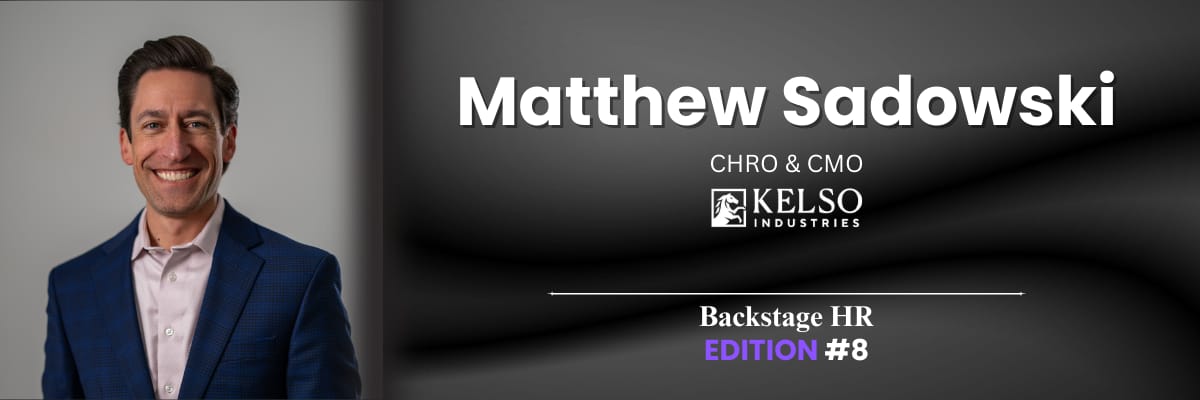
MEET TODAY’S GUEST
Matthew Sadowski
Matthew Sadowski is the Chief Human Resources Officer and Chief Marketing Officer at Kelso Industries, a rapidly growing MEP services company operating across the U.S. He leads people, brand, and systems strategy as the business continues to scale through acquisition and organic growth.
Today, he shares why sustainable growth starts with structure, and why HR only works when it is anchored in business performance.
THE INTERVIEW
Build the System First
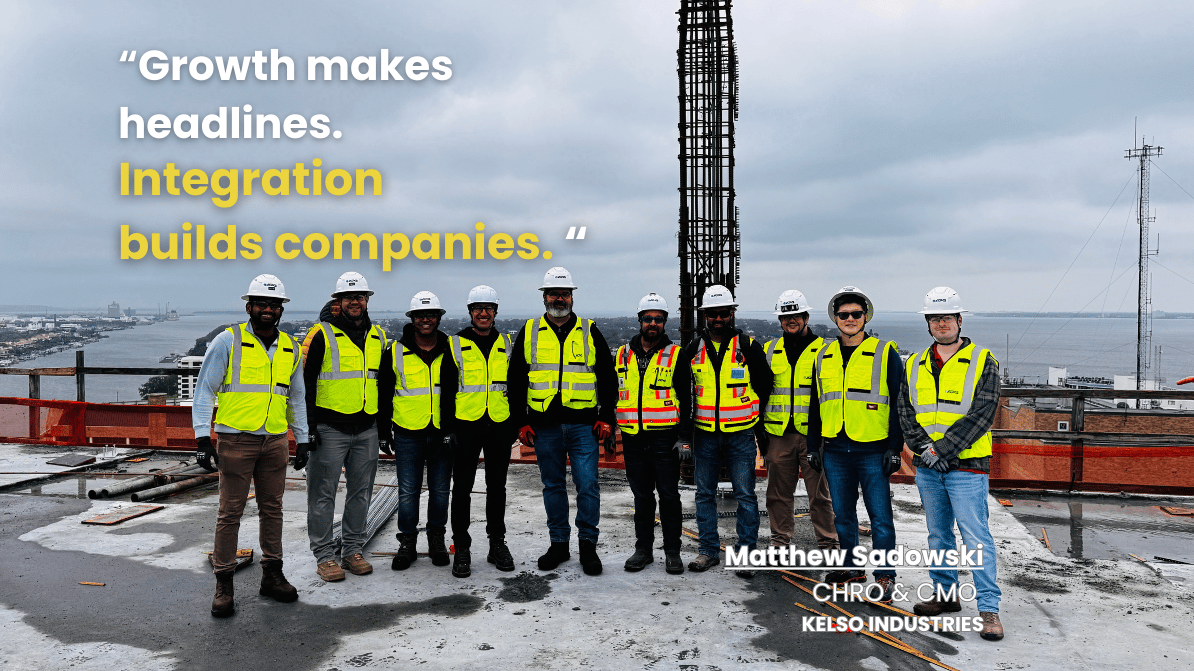
Growth makes headlines.
Integration builds companies.
That distinction defines Matthew Sadowski’s approach to leadership.
At Kelso Industries, growth has been real and rapid. More than 30 acquisitions in less than five years across electrical, mechanical, plumbing, and service markets.
From the outside, that kind of expansion looks exciting.
Inside, it exposes everything.
Systems get tested.
Communication gets strained.
Leaders either align, or they drift.
That is where the real work begins.
And for Matthew, that work starts with one principle:
Build the system first.
From Finance to Leadership
Matthew did not plan on building a career in HR.
He grew up in Utah, met his wife in third grade, and once considered a career in music before choosing business as the steadier path. He studied finance and economics, then entered the MBA program at Brigham Young University, expecting a traditional business trajectory.
An assessment suggested HR. He followed the nudge into an internship at Honeywell and discovered something finance models rarely capture.
Businesses do not run on spreadsheets.
They run on leadership.
“My finance background helped me focus on using people data to make better decisions. But leadership is what differentiates a business.”
In service industries, companies are not selling products.
They are selling people.
Trusted With More
Early in his career, Matthew helped lead a major reorganization affecting nearly 9,000 employees.
It was more responsibility than he expected at that stage.
“The project was way over my head.”
But instead of pulling back, his leader coached him through it. Week by week. Decision by decision.
That experience shaped how he develops leaders today.
You do not wait until someone feels fully ready. You give them responsibility, support them, and let them grow into it.
Hard work. Determination. Collaboration.
The fundamentals still apply.
HR Is Business Strategy
Matthew is clear about the role of HR.
HR exists to help the business grow and succeed. Period.
He is careful with language. The idea of “internal customers” does not resonate with him. HR’s responsibility is not to sit adjacent to the business. It is to strengthen it.
At Kelso, that belief becomes practical.
Acquisitions create opportunity. They also create complexity. Different systems. Different reporting structures. Different cultures that were successful on their own.
Before you optimize anything, you have to connect it.
Before the Dashboard Comes the Foundation
Many organizations talk about having too much data.
Kelso’s challenge has been more foundational.
“We need the data first.”
You cannot improve what you cannot see.
And you cannot see clearly if everything lives in different systems.
Before AI. Before advanced analytics. Before optimization.
There is integration work.
Before you optimize anything,
you have to connect it.
The executive team built a focused scorecard to clarify what truly matters. Gross profit per labor hour. Working capital. Core operating indicators.
“We developed a scorecard and said, these are the most important items we need to collect. Some of them we don’t even have today.”
It is not flashy.
It is structural.
Build the system first.
Then improve it.
Why Marketing Sits at the Same Table
Matthew also leads Marketing, which fits naturally in a relationship-driven industry.
“In this industry, it’s word of mouth and relationships. That’s how growth happens.”
Recruiting and brand are intertwined. Kelso recently refreshed its identity and began co-branding operating companies under the “A Kelso Industries Company” banner. It signals shared strength without erasing local credibility.
The strategy is not about noise.
It is about consistency.
Over time, alignment across operating companies becomes a growth engine of its own.
But only if everyone understands how they fit together.
The Real Work Is Communication
When asked what feels most demanding right now, Matthew does not mention closing the next deal.
He mentions communication.
“We need to be communicating more and more and more.”
In high-growth environments, silence creates stories.
And stories create friction.
As systems mature and structures evolve, leaders need clarity. Not just updates, but direction.
Kelso is moving out of its startup phase and into something more structured. Still ambitious. Still growing. But increasingly focused on alignment.
Growth will continue.
But alignment will determine the outcome.
A conversation on scaling, integration, and leading through constant growth.
What Actually Matters
As the conversation shifts, so does the perspective.

Matthew talks about parenting teenagers and adults. About consistency. About long-term thinking.
He remembers advice that stayed with him.
Your family will not care what title you held. They care that you love them.
For someone who spends his days building systems and aligning leaders, that perspective is not separate from how he leads.
Strong organizations are built on clarity and trust.
So are families.
He builds systems.
He integrates companies.
He aligns leaders.
Growth is exciting.
Systems are quiet.
But systems are what last.